
Words of Praise
“When I read a Marcus Slease poem I am reminded that the world is made up of billions of parts, each with their own soul, each with a great ability to illuminate the sacred while also misbehaving. Slease is a poet who reminds us the wildness of life is not something we can control or even fight against but rather something we should witness and honour.”
– Matthew Dickman, author of Wonderland
Slease refuses the comforts of rootedness, stability, permanence. In doing so, he represents what the philosopher Rose Braidotti identifies as the model of nomadic subjectivity “in flux, never opposed to a dominant hierarchy yet intrinsically other, always in the process of becoming, and perpetually engaged in dynamic power relations both creative and restrictive.”
– Piotr Gwiazda, author of US Poetry in the Age of Empire, 1979-2012
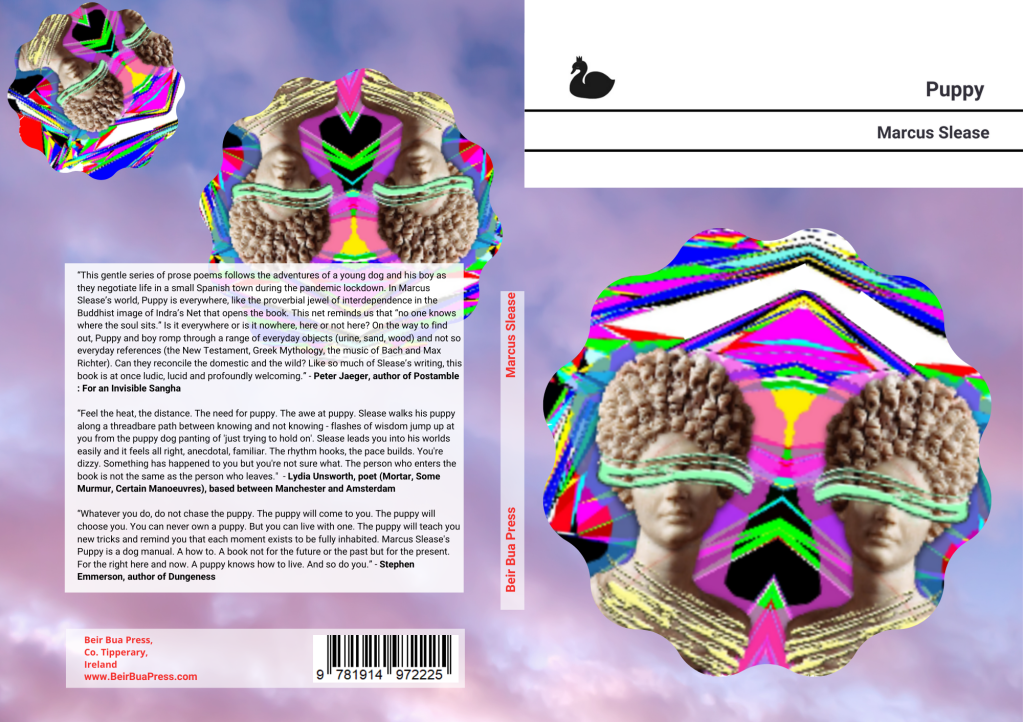
“This gentle series of prose poems follows the adventures of a young dog and his boy as they negotiate life in a small Spanish town during the pandemic lockdown. In Marcus Slease’s world, Puppy is everywhere, like the proverbial jewel of interdependence in the Buddhist image of Indra’s Net that opens the book. This net reminds us that “no one knows where the soul sits.” Is it everywhere or is it nowhere, here or not here? On the way to find out, Puppy and boy romp through a range of everyday objects (urine, sand, wood) and not so everyday references (the New Testament, Greek Mythology, the music of Bach and Max Richter). Can they reconcile the domestic and the wild? Like so much of Slease’s writing, this book is at once ludic, lucid and profoundly welcoming.” – Peter Jaeger, author of Postamble : For an Invisible Sangha
“Feel the heat, the distance. The need for puppy. The awe at puppy. Slease walks his puppy along a threadbare path between knowing and not knowing – flashes of wisdom jump up at you from the puppy dog panting of ‘just trying to hold on’. Slease leads you into his worlds easily and it feels all right, anecdotal, familiar. The rhythm hooks, the pace builds. You’re dizzy. Something has happened to you but you’re not sure what. The person who enters the book is not the same as the person who leaves.” – Lydia Unsworth, poet (Mortar, Some Murmur, Certain Manoeuvres), based between Manchester and Amsterdam
“Whatever you do, do not chase the puppy. The puppy will come to you. The puppy will choose you. You can never own a puppy. But you can live with one. The puppy will teach you new tricks and remind you that each moment exists to be fully inhabited. Marcus Slease’s Puppy is a dog manual. A how to. A book not for the future or the past but for the present. For the right here and now. A puppy knows how to live. And so do you.” – Stephen Emmerson.
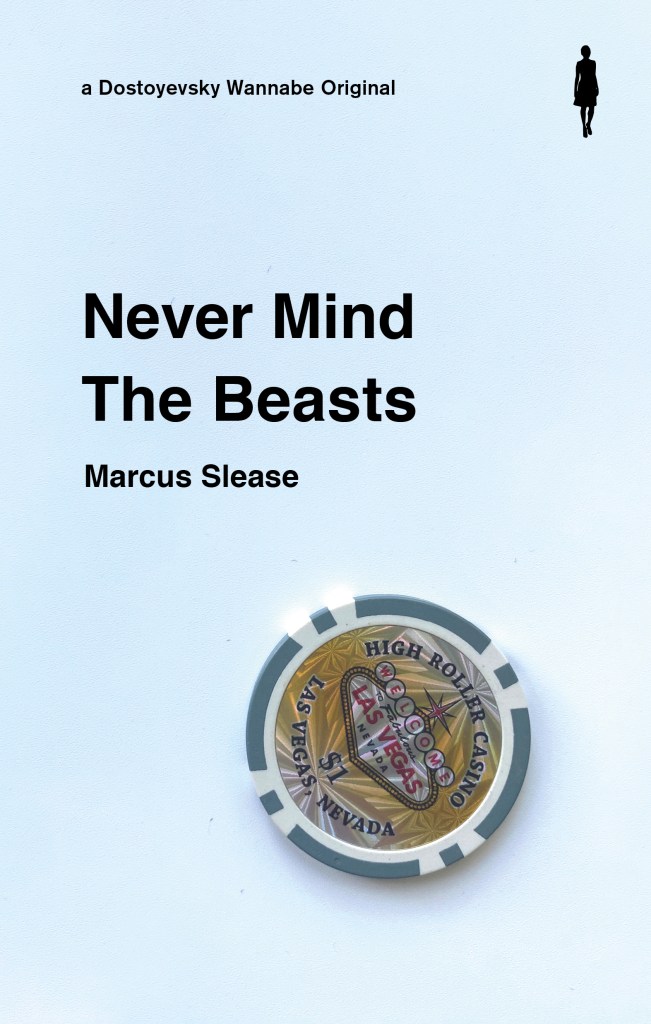
“Say Lydia Davis and Donald Barthelme had a son, and his life story was painted by Basquiat, and the paintings were ground up into a spice, then used to flavour a crazy-hot dish you just can’t stop eating while the scenery shifts around you: that taste might be something like Never Mind the Beasts.”
—Ruby Cowling, author of This Paradise
“Writing actually as love! Marcus Slease’s crinkling, crackling prose is full of sparks, full of troubles, full of wonder. Never Mind the Beasts radiates with the force, brevity and immediacy of stylists like Mary Robison, Rikki Ducornet and Diane Williams. “The demand to love,” wrote Roland Barthes at the beginning of Roland Barthes by Roland Barthes; “overflows, leaks, skids, shifts, slips.” “Writing to touch with letters, with lips, with breath,” wrote Hélène Cixous in Coming to Writing. These are the thrilling, vibratory spaces, movements and possibilities Slease’s writing opens up.”
—Colin Herd, author of You Name It
“Stylewise it would appeal to fans of both abrupt American Lydia Davis and Soviet absurdist Daniil Kharms . . . A Portrait of the Artist for the Tyskie and Kimchi generation.”
– Robert Greer, Book Reviewer for Idler Magazine
“Robust pro aktiv quixotik goes evreewher is from evreewher nouns ar verbs verbs ar yu a nu way uv intraktivitee langwage th narrativ rocks takes yu evreewher thers no conclewsyun its in th going, wundrful a great xperiens ths book.”
—bill bissett, author of Breth
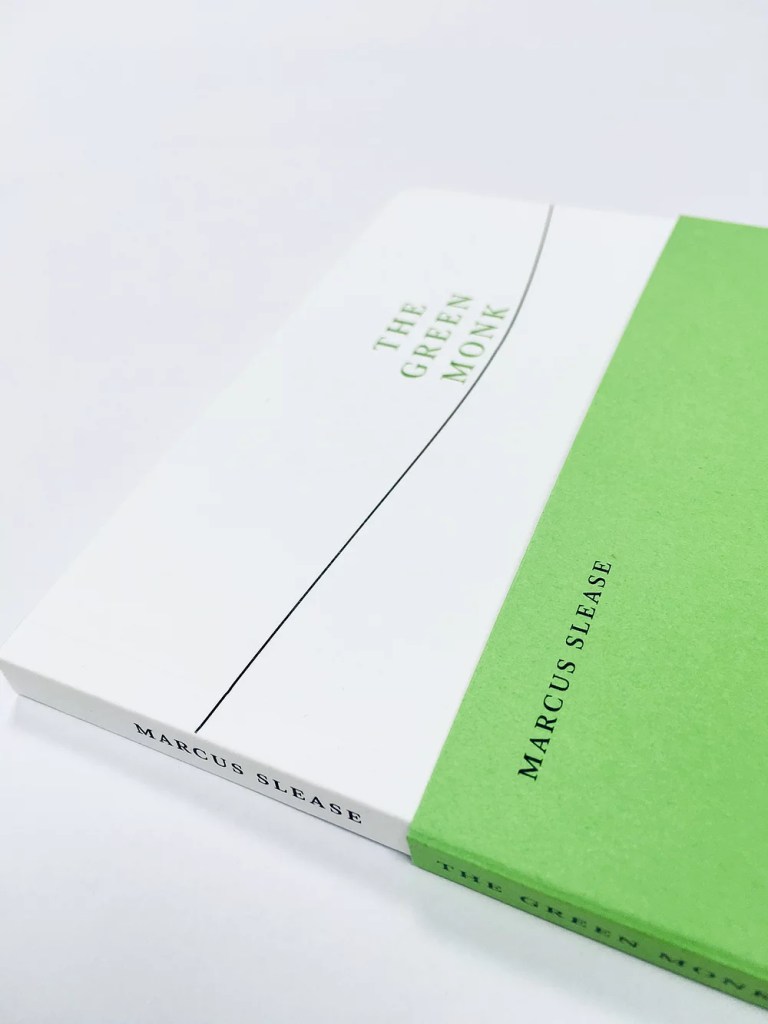
“Slease’s work, like that of Kharms, is absurdist but rooted in the quotidian. In The Green Monk, the magical and the mundane exist not in opposition but in symbiosis.”
—Tom Jenks, author of A Long and Hard Night Troubled by Visions

“Marcus Slease’s gentle & generous engagements with the ephemera of almost-everyday life, coupled with a variant of bill bissett’s Lunarian English, and a sensuous, curious, cosmopolitan, and compassionate world-view, make this happily humble beautifully-modulated everything collection—without any shadow-of-a-doubt—my book of the year. For 1973 and for 2017.”
—Tim Atkins, author of NOTHING CONCLUSIVE HAS YET TAKEN PLACE IN THE WORLD THE ULTIMATE WORD OF THE WORLD AND ABOUT THE WORLD HAS NOT YET BEEN SPOKEN THE WORLD IS OPEN AND … IS STILL IN THE FUTURE AND WILL ALWAYS BE
“There is a lot of humor in the book and a wildness that creates the effect of a voyeuristic dreamscape.”
– Laura Wetherington, author of Parallel Resting Places
 Never Mind the Beasts